Missing Track File Analysis
Missing Track File Analysis scans your library for tracks whose audio file can no longer be found at the path stored in the database. When a track points at a file that has been moved, renamed or deleted on the server, the track is reported so you can remove the orphaned entry.
Missing files usually happen when audio that was added to the library with the Files on Server or Folder on Server methods is later moved, renamed or deleted outside PlayIt Manager, or when the drive or network share holding the files is no longer available. A track whose file is missing cannot be played, so leaving the entry in the library means it can still be scheduled and then fail to play.
The tool checks each track's stored file path. Tracks added with Upload to Server are copied into the Audio Store folder, so they are only reported if the file has been removed from the Audio Store itself.
To open the page, go to Tools and select the Missing Track Files tab. This tab is only available to users with the Manage Tracks permission.
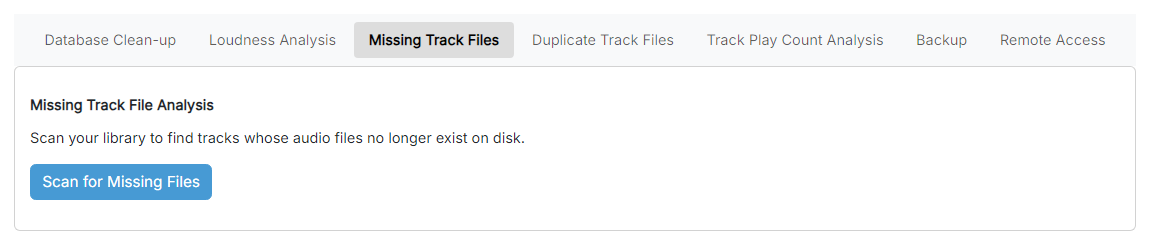
The Missing Track File Analysis page, reached from the Tools section.
Click Scan for Missing Files to begin scanning. When it finishes, any tracks whose file could not be found are listed in the results table. If every track's file is present, a confirmation message that no missing track files were found is shown instead.
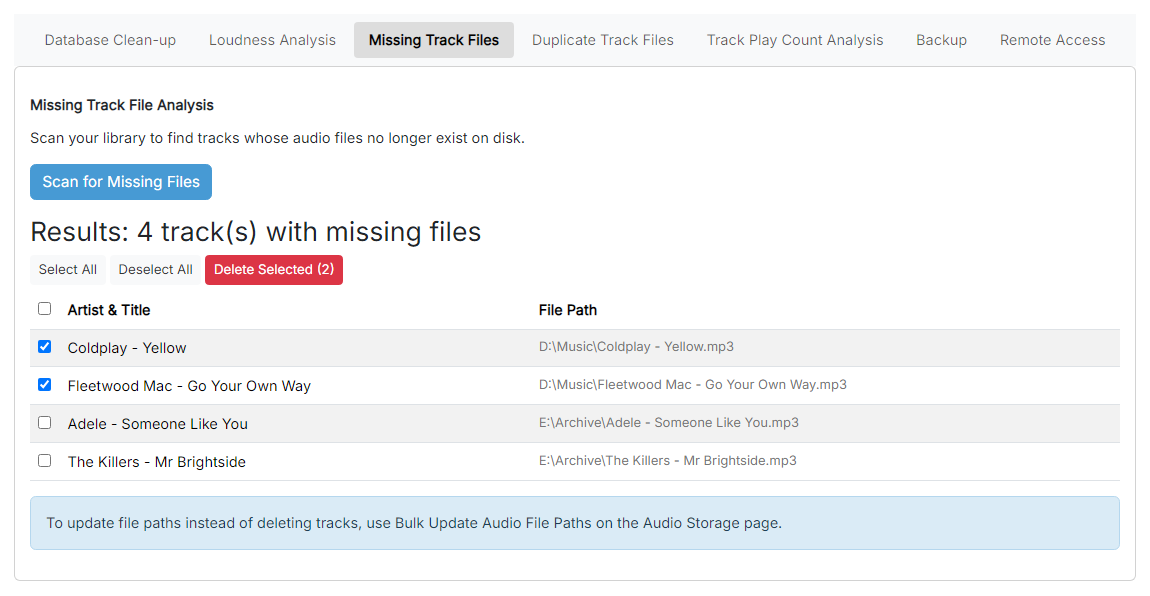
The results of a scan, with missing tracks selected ready for removal.
Each row in the results table represents a track whose audio file is missing. Review the rows and tick the checkbox next to each track you want to remove. Use Select All or the header checkbox to tick every row at once, and Deselect All to clear the selection.
When you are happy with your selection, click Delete Selected (N), where N is the number of ticked rows. You are asked to confirm because the tracks are permanently removed from the database and this cannot be undone. Only the track entries are removed; no audio files are touched, since the files are already missing.
If the files have only moved rather than being deleted, you may prefer to correct the paths instead of removing the tracks. Use Bulk Update Audio File Paths on the Audio Storage page to point the affected tracks at their new location rather than deleting them here.