Edit QuickCart Window
The Edit QuickCart window allows you to edit individual QuickCart settings. Open it from the main window by switching to Edit operation mode and clicking the cart you want to change.
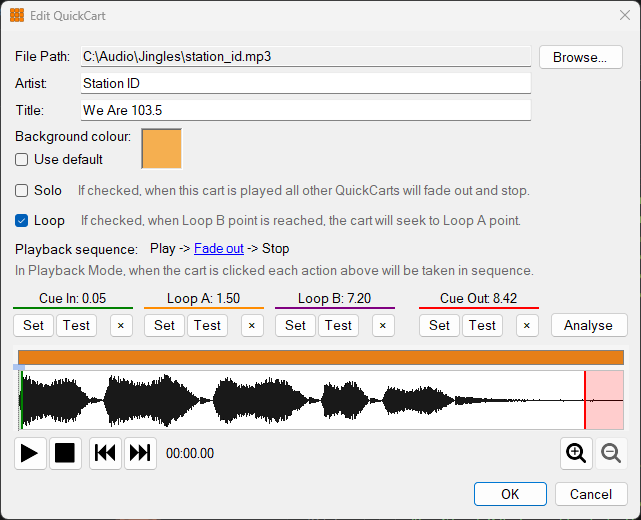
File path

The path to the audio file on the file system. The audio is not copied, so the file must remain at this location for the cart to play. Click the Browse button to select a new audio file, for example if the original has been moved.
Artist

Edit the artist text to change the artist that is displayed on the QuickCart on the main window.
Title

Edit the title text to change the title that is displayed on the QuickCart on the main window.
Background colour
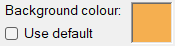
Click the colour box to select a new background colour for the QuickCart. Click Use default to revert to the default colour configurable in Settings.
Solo

If Solo is checked, when the cart is played it will cause all other carts to fade out and stop. This cart will also fade out and stop when any other cart starts playing. Solo ensures this cart is the only cart playing at any particular time.
Loop

If Loop is checked, when the cart is played it will loop between points Loop A and Loop B. The Loop A and Loop B cue points will appear in the Cue Points section when Loop is checked. If Loop B is not set, the cart will loop from the end of the cart. If Loop A is not set, the cart will seek to the Cue In point when the loop point is reached.
Playback sequence

The playback sequence determines how the cart behaves when the cart is clicked on the main interface. In this example, the cart will Play, then Fade out, then Stop in turn for each mouse click. To change how the cart behaves, click any blue link, for example clicking Fade out lets you choose Stop instead so that the sequence becomes Play then Stop.
For looping carts there are additional options. Cease loop stops the cart from looping any further so it behaves like a non-looping cart. Go to Loop B causes the cart to jump to the end of the loop sequence, which is useful for a background bed that loops but also has an outro you want the listener to hear when you have finished speaking.
Cue points

The Cue In point is the position in seconds where the track should be started by a player. Use the Set button while listening to the track to set the point to the current position. Use the Test button to listen to the track from the set position.
The Cue Out point is the position in seconds where the track finishes. This is the point at which a segue triggers the next QuickCart. By default it is set to the end of the audio. Use the Set button to set the point to the current position and the Test button to preview it.
For looping carts there are two additional cue points, Loop A and Loop B, which define the start and end of the loop region. Use the Set and Test buttons next to each to capture and preview them.
Waveform

The waveform shows the volume of the audio track over time. The Cue In point set above is overlaid on the waveform in green and the Cue Out point in red, and for looping carts the Loop A and Loop B points are also shown. Double-click anywhere on the track to play from that position. Use the mouse wheel or the zoom in and out buttons to zoom in to set a cue point more precisely.
Playback buttons

Use the Play and Stop buttons to listen to the track. Use the Back and Forward buttons to jump to the start and end of the track. The current position in the track is shown alongside the buttons. The audio device used to play back the audio can be configured in Settings.
Analyse button

Click the Analyse button to automatically detect the Cue In point based on the silence at the start of the QuickCart track.
OK button

Click OK to confirm changes to the QuickCart.
Cancel button

Click Cancel to discard changes to the QuickCart.